
GAY
FILM REVIEWS BY MICHAEL D. KLEMM


|
||||||
|
GAY
FILM REVIEWS BY MICHAEL D. KLEMM
|
||||||
|
|
|
|
|
|
|
|
The
Blossoming TLA
Releasing, Director:
Screenplay:
Starring:
Unrated, 100 minutes
Le Leon Waterbearer
Films, Director/Screenplay:
Starring:
Unrated, 85 minutes |
Secret
Worlds
One of the great things about the movies is the way they can take us to worlds, cultures and exotic locales that we might never otherwise experience on our own. The following short reviews are foreign films that examine queer identity in various parts around the globe. |
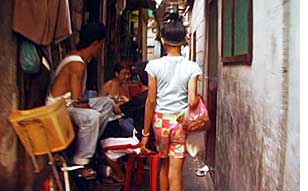 Our
first trip is to the Philippines for a festival favorite, directed by Auraeus
Solito from a screenplay by Michiko Yamamoto, entitled The
Blossoming of Maximo Oliveros. The setting is the slums of
Manila. It is the coming of age story of a 12 year old boy named Maximo
(Nathan Lopez), a happy gay kid who is experiencing his first serious crush
on an older man. Maxi likes to wear girly clothes with flowers in his hair.
The camera often follows him as he gyrates his hips and sashays through
his neighborhood streets, with confidence and attitude, as if he were commanding
a fashion runway. When he isn't watching movies with friends, or participating
in pretend beauty pageants, he is taking care of the household where he,
his widowed father, and two older brothers live. Maxi cleans the apartment,
cooks dinner, mends their clothes and braids his older brother's long hair.
Rather than being Cinderella, he is the belle of the ball and he loves every
minute of it. Our
first trip is to the Philippines for a festival favorite, directed by Auraeus
Solito from a screenplay by Michiko Yamamoto, entitled The
Blossoming of Maximo Oliveros. The setting is the slums of
Manila. It is the coming of age story of a 12 year old boy named Maximo
(Nathan Lopez), a happy gay kid who is experiencing his first serious crush
on an older man. Maxi likes to wear girly clothes with flowers in his hair.
The camera often follows him as he gyrates his hips and sashays through
his neighborhood streets, with confidence and attitude, as if he were commanding
a fashion runway. When he isn't watching movies with friends, or participating
in pretend beauty pageants, he is taking care of the household where he,
his widowed father, and two older brothers live. Maxi cleans the apartment,
cooks dinner, mends their clothes and braids his older brother's long hair.
Rather than being Cinderella, he is the belle of the ball and he loves every
minute of it. |
|
|
|
|
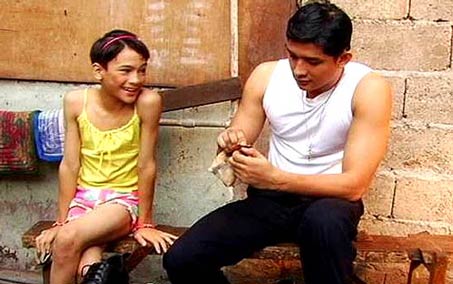
 One
night, Maxi is attacked by some thugs and is rescued, and carried home,
by Victor (J.R. Valentin), a new, inexperienced, and quite hunky young policeman
who has been assigned to their beat. Before long Maxi is in the throes of
puppy love. This, however, is not a good thing as far as his family is concerned.
They are used to the local police turning the other way but Victor doesn't
seem to want to get with the program. As the lovesick Maxi follows Victor
around, the young cop takes a paternal interest in the lad and begins to
ask a few too many questions. One
night, Maxi is attacked by some thugs and is rescued, and carried home,
by Victor (J.R. Valentin), a new, inexperienced, and quite hunky young policeman
who has been assigned to their beat. Before long Maxi is in the throes of
puppy love. This, however, is not a good thing as far as his family is concerned.
They are used to the local police turning the other way but Victor doesn't
seem to want to get with the program. As the lovesick Maxi follows Victor
around, the young cop takes a paternal interest in the lad and begins to
ask a few too many questions. |
|
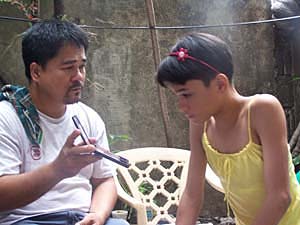 Victor
tells Maxi that he should go back to school so that he can better himself
and someday earn an honest living. Now that the boy's affections are torn,
his household bliss is shattered as the lovesick boy begins to question,
for the first time, his family's life of crime. When he broaches this subject,
his father is angry and asks the boy why he is suddenly ashamed of his own
blood. A nice example of the film's complexities occurs when Paco explains
to his son that he makes a better living this way than when he once worked
in a factory for slave wages, with no health benefits, and was unable to
afford the medical care that was needed by the boy's mother before she died. Victor
tells Maxi that he should go back to school so that he can better himself
and someday earn an honest living. Now that the boy's affections are torn,
his household bliss is shattered as the lovesick boy begins to question,
for the first time, his family's life of crime. When he broaches this subject,
his father is angry and asks the boy why he is suddenly ashamed of his own
blood. A nice example of the film's complexities occurs when Paco explains
to his son that he makes a better living this way than when he once worked
in a factory for slave wages, with no health benefits, and was unable to
afford the medical care that was needed by the boy's mother before she died.
|
|
 Up
to this point, the film has been, for the most part, rather delightful and
lighthearted but things take a dark turn when Maxi's oldest brother is (rightly)
accused of killing someone in a botched robbery. Victor is becoming a problem
and Maxi's family decides to teach him a lesson. Maxi is horrified by this
turn of events and sneaks out to see to, and bathe, the badly beaten cop's
wounds. This is a very touching interlude, which mirrors an earlier scene
in which Maxi bathed a young toddler in a garbage-strewn alley. Maxi gives
Victor a small kiss on the cheek and the cop realizes that he has to put
some distance between them. At this point, things begin to get ugly. Up
to this point, the film has been, for the most part, rather delightful and
lighthearted but things take a dark turn when Maxi's oldest brother is (rightly)
accused of killing someone in a botched robbery. Victor is becoming a problem
and Maxi's family decides to teach him a lesson. Maxi is horrified by this
turn of events and sneaks out to see to, and bathe, the badly beaten cop's
wounds. This is a very touching interlude, which mirrors an earlier scene
in which Maxi bathed a young toddler in a garbage-strewn alley. Maxi gives
Victor a small kiss on the cheek and the cop realizes that he has to put
some distance between them. At this point, things begin to get ugly. |
|
 I
thought that some of the later plot developments stretched credibility but,
then again, I know nothing about Filipino streetlife. The
Blossoming of Maximo Oliveros is a unique film that really
isn't about homosexuality at all; it is but one component in a rich tapestry.
Director Solito's camera takes us right into the heart of both darkness
and light, and the viewer is treated to both Manila's local color and its
third world squalor. We see a toothless man banging away at an out-of-tune
piano; abandoned cars and trash piled high in stagnant water; people living
in poverty but not beaten down by it. And through all this, everyone just
seems to love Maxi. I
thought that some of the later plot developments stretched credibility but,
then again, I know nothing about Filipino streetlife. The
Blossoming of Maximo Oliveros is a unique film that really
isn't about homosexuality at all; it is but one component in a rich tapestry.
Director Solito's camera takes us right into the heart of both darkness
and light, and the viewer is treated to both Manila's local color and its
third world squalor. We see a toothless man banging away at an out-of-tune
piano; abandoned cars and trash piled high in stagnant water; people living
in poverty but not beaten down by it. And through all this, everyone just
seems to love Maxi. |
|
|
The Blossoming of Maximo Oliveros won the Teddy Award for Best Picture at the 2006 Berlin International Film Festival, and was the Philippines' official entry for the 2007 Oscars.
|
|
 |
|
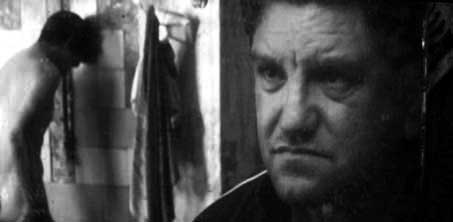
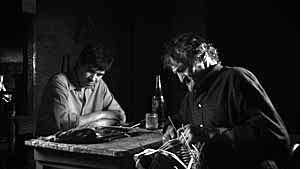
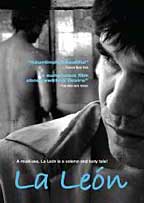
| La Leon takes place in the native country of Argentinean writer/director, Santiago Otheguy. The setting is the Panera Delta, a labyrinth of waterways and wetlands far from civilization; a primordial jungle, sparsely populated, and accessible only by boat. The indigenous peoples' only link to larger towns and the outside world is a bus-like water taxi named El Leon (the lion). The boat's operator is El Turo (Daniel Valenzuela), a burly and violent man who relishes his role as patriarch to the poverty-stricken natives who depend upon him for transportation. | |
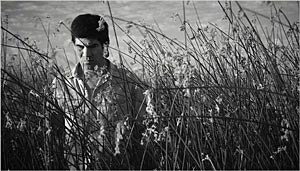 Alvaro
(Jorge Roman) makes a meager living by harvesting reeds, with a much older
man named Iribarren, and repairing books for the nearest town's small library.
Mostly a loner, he is also a gay man who gets to enjoy an occasional tryst
with strangers who pass through the maze-like waterways. He is also the
object of El Turo's contempt and much of the film chronicles the antagonistic
relationship between these two men. Alvaro
(Jorge Roman) makes a meager living by harvesting reeds, with a much older
man named Iribarren, and repairing books for the nearest town's small library.
Mostly a loner, he is also a gay man who gets to enjoy an occasional tryst
with strangers who pass through the maze-like waterways. He is also the
object of El Turo's contempt and much of the film chronicles the antagonistic
relationship between these two men. |
|
 El
Turo is threatened by the presence of nomads illegally harvesting timber
in the jungle. (The film calls them "missionaries." which was a source of
much confusion for this reviewer.) El Turo accuses Alvaro of aiding these
invaders, while also indulging his other favorite pastime by harassing Alvaro
for being a "faggot." Their paths cross more than each would prefer because
both are involved, in some capacity, with the local soccer team. El Turo
joins a long list of possibly-closeted cinematic villains when we watch
him primp his pompadour hair while watching, out of the corner of his eye,
as Alvaro washes himself in the shower. Their simmering tensions eventually
come to a boil. El
Turo is threatened by the presence of nomads illegally harvesting timber
in the jungle. (The film calls them "missionaries." which was a source of
much confusion for this reviewer.) El Turo accuses Alvaro of aiding these
invaders, while also indulging his other favorite pastime by harassing Alvaro
for being a "faggot." Their paths cross more than each would prefer because
both are involved, in some capacity, with the local soccer team. El Turo
joins a long list of possibly-closeted cinematic villains when we watch
him primp his pompadour hair while watching, out of the corner of his eye,
as Alvaro washes himself in the shower. Their simmering tensions eventually
come to a boil. |
|
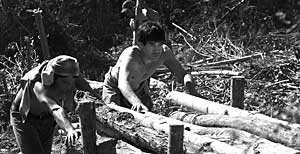 Grooming
while gazing into a mirror is a visual motif that connects the two men.
Alvaro will indulge his own voyeurism when he works for a day, felling lumber,
with the missionaries. He steals sideward glances at another shirtless man
and then later watches him bathe in the river. Earlier, while rowing his
small boat through the wetlands, he makes eye contact with a transient on
a passing vessel. The camera keeps its distance as the two men share a moment
of passionate sex; their figures almost lost in the surrounding jungle vegetation. Grooming
while gazing into a mirror is a visual motif that connects the two men.
Alvaro will indulge his own voyeurism when he works for a day, felling lumber,
with the missionaries. He steals sideward glances at another shirtless man
and then later watches him bathe in the river. Earlier, while rowing his
small boat through the wetlands, he makes eye contact with a transient on
a passing vessel. The camera keeps its distance as the two men share a moment
of passionate sex; their figures almost lost in the surrounding jungle vegetation. |
|
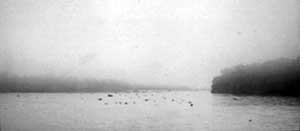 La
Leon
is filmed in black and white Cinemascope, and the wide screen photography
celebrates the native locales. The river, itself, is almost the star of
the movie. There are repeated point-of-view shots down the waterways that
might remind viewers of a similar cinematic journey in Francis Ford Coppola's
Apocalypse Now, not to mention Werner Herzog's Aguirre, the Wrath
Of God and Fitzcarraldo. Like the films of Terrence Mallick (Days
of Heaven), the landscape is the focus and the people are sometimes
nothing but pawns on nature's broad canvas. The quiet images of reeds rustling
in the waters in the wake of El Leon passing can stand as a metaphor of
man's invasion of this almost unspoiled wilderness. The film's pacing is
like the slow ebbing currents of the great river. La
Leon
is filmed in black and white Cinemascope, and the wide screen photography
celebrates the native locales. The river, itself, is almost the star of
the movie. There are repeated point-of-view shots down the waterways that
might remind viewers of a similar cinematic journey in Francis Ford Coppola's
Apocalypse Now, not to mention Werner Herzog's Aguirre, the Wrath
Of God and Fitzcarraldo. Like the films of Terrence Mallick (Days
of Heaven), the landscape is the focus and the people are sometimes
nothing but pawns on nature's broad canvas. The quiet images of reeds rustling
in the waters in the wake of El Leon passing can stand as a metaphor of
man's invasion of this almost unspoiled wilderness. The film's pacing is
like the slow ebbing currents of the great river. |
|
|
|
|
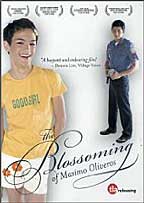
 One
would expect his family to tell him to stop acting like a girl but, aside
from gentle teasing, they accept him the way he is; as do the colorful
neighborhood denizens. Maxi's existence seems almost idyllic. He is comfortable
in his skin and all is right with the world. His father, Paco, and his
two siblings, Boy and Bogs, make a comfortable, but illicit, living as
petty thieves who deal in racketeering and peddling stolen cellphones.
Paco appears to be a sort of minor crime don who commands the community's
respect. Paco seems to have an understanding with the local police but
all of that is about to change.
One
would expect his family to tell him to stop acting like a girl but, aside
from gentle teasing, they accept him the way he is; as do the colorful
neighborhood denizens. Maxi's existence seems almost idyllic. He is comfortable
in his skin and all is right with the world. His father, Paco, and his
two siblings, Boy and Bogs, make a comfortable, but illicit, living as
petty thieves who deal in racketeering and peddling stolen cellphones.
Paco appears to be a sort of minor crime don who commands the community's
respect. Paco seems to have an understanding with the local police but
all of that is about to change.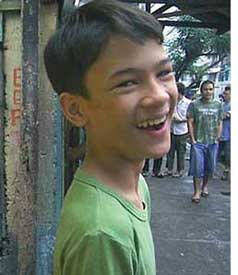 Nathan
Lopez is a sheer delight as Maxi. His exuberance and joy will suck you
into the film and you will be all the more glad for the experience. There
is nothing bratty or annoying about this kid and Hollywood could learn
a thing or two by watching films like this and maybe they might make better
casting decisions when it comes to child actors. The
Blossoming of Maximo Oliveros was shot on digital video
and, while some of the night photography is a bit muddy, the imagery is
superb. It is a combination of National Geographic with the neorealism
of Vittorio De Sica's The Bicycle Thief. Most of the background
score is performed on a twangy acoustic guitar whose plucked strings evoke
an Indonesian flair. The mood of the music was oddly familiar and I had
one of those "ah ha!" moments when the film ended with a clever
homage to the final shot of Carol Reed's The Third Man and I remembered
that classic film's haunting zither melodies.
Nathan
Lopez is a sheer delight as Maxi. His exuberance and joy will suck you
into the film and you will be all the more glad for the experience. There
is nothing bratty or annoying about this kid and Hollywood could learn
a thing or two by watching films like this and maybe they might make better
casting decisions when it comes to child actors. The
Blossoming of Maximo Oliveros was shot on digital video
and, while some of the night photography is a bit muddy, the imagery is
superb. It is a combination of National Geographic with the neorealism
of Vittorio De Sica's The Bicycle Thief. Most of the background
score is performed on a twangy acoustic guitar whose plucked strings evoke
an Indonesian flair. The mood of the music was oddly familiar and I had
one of those "ah ha!" moments when the film ended with a clever
homage to the final shot of Carol Reed's The Third Man and I remembered
that classic film's haunting zither melodies.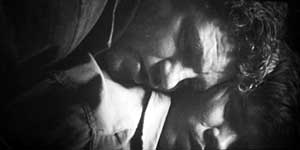 To
be honest, not very much happens in La Leon.
It is a rather cold film that never lets us completely know its characters.
Director Otheguy will linger on a close-up of an old man's withered face
or a pair of gnarled hands, center on the back of another's head, or let
a figure become swallowed up by the wild and untamed landscape. There
is striking realism because the film is mostly populated by the delta's
local inhabitants; only Alvaro and El Turo are played by professional
actors. But because the script contains very little dialogue, and there
are few dramatic peaks, our emotions are never engaged. La
Leon is a diamond in the rough but will probably tax the
patience of audiences weaned on action movies. Still, there is a hypnotic
power to the film's languid images, and La
Leon is a window into an unknown and mysterious world.
To
be honest, not very much happens in La Leon.
It is a rather cold film that never lets us completely know its characters.
Director Otheguy will linger on a close-up of an old man's withered face
or a pair of gnarled hands, center on the back of another's head, or let
a figure become swallowed up by the wild and untamed landscape. There
is striking realism because the film is mostly populated by the delta's
local inhabitants; only Alvaro and El Turo are played by professional
actors. But because the script contains very little dialogue, and there
are few dramatic peaks, our emotions are never engaged. La
Leon is a diamond in the rough but will probably tax the
patience of audiences weaned on action movies. Still, there is a hypnotic
power to the film's languid images, and La
Leon is a window into an unknown and mysterious world.