
GAY
FILM REVIEWS BY MICHAEL D. KLEMM


|
||||||
|
GAY
FILM REVIEWS BY MICHAEL D. KLEMM
|
||||||
|
|
|
|
|
|
|
|
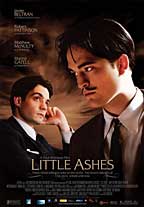
Little Ashes Regency Entertainment, Director: Screenplay Starring: Rated R, 112 minutes |
Portraits
Of The Artists As Young Men
The friendships that form between fellow artists have always held a certain fascination, especially when the bond also enters the realm of the sexual. The interpersonal relationships between the Beat writers of the 1950s were just as interesting as their published books; likewise for the artists and authors of the Harlem Renaissance. Three of Spain's most celebrated 20th century artists attended university together during the 1920s. Little Ashes, a 2009 film by Paul Morrison, explores the passionate fellowship - that may or may not have also been sexual - between the famed poet/playwright Federico Garcia Lorca (1898-1936) and the painter Salvador Dali (1904-1989). |
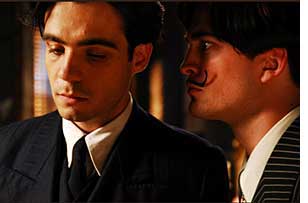 The
prevailing atmosphere in Spain was conservative and Catholic. In another
ten years, the country would be plunged into civil war and it was the perfect
time to be a revolutionary artist. Not to mention a Surrealist. Little
Ashes opens in 1922 at The Residencia de Estudiantes, a prominent
school for the arts in Madrid. It is there that Federico Lorca (Javier Beltram)
and his friend, Luis Bunuel (Matthew McNulty), witness the flamboyant arrival
of Salvador Dali (Twilight's Robert Pattinson). Before we go further,
let me first introduce the three prominent historical figures in Little
Ashes. The
prevailing atmosphere in Spain was conservative and Catholic. In another
ten years, the country would be plunged into civil war and it was the perfect
time to be a revolutionary artist. Not to mention a Surrealist. Little
Ashes opens in 1922 at The Residencia de Estudiantes, a prominent
school for the arts in Madrid. It is there that Federico Lorca (Javier Beltram)
and his friend, Luis Bunuel (Matthew McNulty), witness the flamboyant arrival
of Salvador Dali (Twilight's Robert Pattinson). Before we go further,
let me first introduce the three prominent historical figures in Little
Ashes. |
|
|
|
|
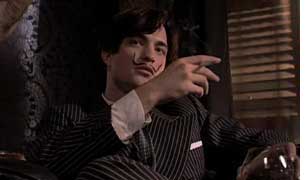 Dali
is perhaps the most famous painter from the Surrealist art movement. His
painting of melting clocks, The Persistence Of Memory (1931), is
as recognized today as his signature moustache. Dali's ego was legendary,
as was his penchant for fame and, especially, wealth. He would even embrace
fascism if he knew he could make a buck. One of the all-time publicity whores,
Dali never missed an opportunity to court attention until he became a parody
of the great artist he once was. Dali
is perhaps the most famous painter from the Surrealist art movement. His
painting of melting clocks, The Persistence Of Memory (1931), is
as recognized today as his signature moustache. Dali's ego was legendary,
as was his penchant for fame and, especially, wealth. He would even embrace
fascism if he knew he could make a buck. One of the all-time publicity whores,
Dali never missed an opportunity to court attention until he became a parody
of the great artist he once was. |
|
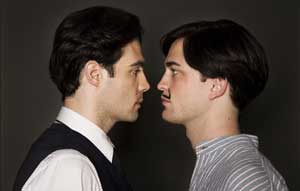 Lorca
and Dali would greatly influence each other's art between 1925 and 1928.
The third artist to feature prominently in Little
Ashes is the great filmmaker Luis Bunuel (1900-1983). Bunuel
and Dali made the notorious Surrealist short film, Un Chien Andalu,
together in 1929. Bunuel eventually left Europe to make films in Mexico,
and is renowned in cinema circles for The Exterminating Angel (1962),
Belle de Jour (1967) and The Discrete Charm Of The Bourgeoisie
(1972). Little Ashes is a portrait
of these artists as young men. Lorca
and Dali would greatly influence each other's art between 1925 and 1928.
The third artist to feature prominently in Little
Ashes is the great filmmaker Luis Bunuel (1900-1983). Bunuel
and Dali made the notorious Surrealist short film, Un Chien Andalu,
together in 1929. Bunuel eventually left Europe to make films in Mexico,
and is renowned in cinema circles for The Exterminating Angel (1962),
Belle de Jour (1967) and The Discrete Charm Of The Bourgeoisie
(1972). Little Ashes is a portrait
of these artists as young men. |
|
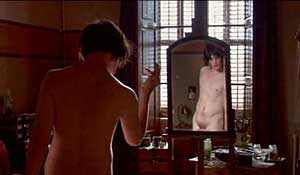
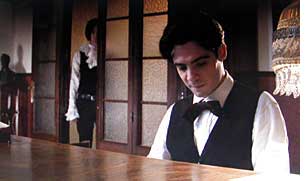 Dali's
first entrance foreshadows his later flair for absurd showmanship. He arrives
at the university with long hair and dressed like Little Lord Faunteroy.
He might as well be in drag but, because he appears to be making a deliberately
shocking "statement," the avante-garde loving students welcome him with
open arms. He is already at pains to create a new persona and he makes sure that one of the
other students takes notice of the "strategically placed copy of Freud"
laying open on the bed. Later, he experiments with his "look" in front of
a mirror, finally standing there naked and feyly posing with a cigarette.
He cuts his hair, slicks it back and wears a suit - and looks even more
androgynous than before. Dali's
first entrance foreshadows his later flair for absurd showmanship. He arrives
at the university with long hair and dressed like Little Lord Faunteroy.
He might as well be in drag but, because he appears to be making a deliberately
shocking "statement," the avante-garde loving students welcome him with
open arms. He is already at pains to create a new persona and he makes sure that one of the
other students takes notice of the "strategically placed copy of Freud"
laying open on the bed. Later, he experiments with his "look" in front of
a mirror, finally standing there naked and feyly posing with a cigarette.
He cuts his hair, slicks it back and wears a suit - and looks even more
androgynous than before. |
|
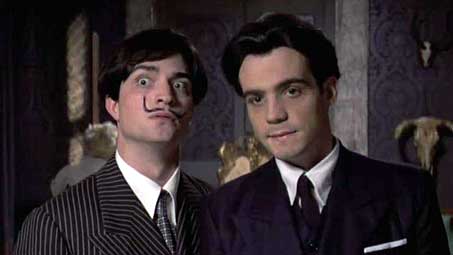
 Frankly,
Robert Pattinson looks ridiculous as Dali, especially when he finally sports
the long, thin, silent film villain moustache. But Dali himself looked
ridiculous and so Pattinson looks exactly as he should. I give Pattinson
credit for taking this role. It was made before he hit mega teen heartthrob
stardom in the Twilight movies but, even so, it was a gutsy acting
challenge. Leonardo DiCaprio did something similar in 1995 when he played
Rimbaud to David Thewlis' Verlaine in Total Eclipse. Frankly,
Robert Pattinson looks ridiculous as Dali, especially when he finally sports
the long, thin, silent film villain moustache. But Dali himself looked
ridiculous and so Pattinson looks exactly as he should. I give Pattinson
credit for taking this role. It was made before he hit mega teen heartthrob
stardom in the Twilight movies but, even so, it was a gutsy acting
challenge. Leonardo DiCaprio did something similar in 1995 when he played
Rimbaud to David Thewlis' Verlaine in Total Eclipse. |
|
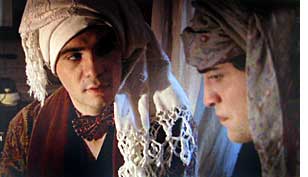 Although
Leslie Stainton's biography of Lorca reports that Bunuel was disgusted by
the possibility that his two friends might be lovers, the film might be
exaggerating the extent of the homophobia he displays. He walks into Lorca's
room and almost catches the two men kissing - and wonders why they are both
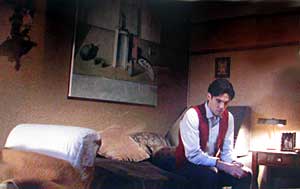
wearing turbans. Later, his eyes dart around the room to the Dali canvas
hanging over Lorca's bed and the framed photo of the artists on the beach,
and he doesn't look happy. We can only hope that when Bunuel goes out and
cruises a gay man, and then beats him up, that it is perhaps a little too
much liberty on the part of the filmmakers. Although
Leslie Stainton's biography of Lorca reports that Bunuel was disgusted by
the possibility that his two friends might be lovers, the film might be
exaggerating the extent of the homophobia he displays. He walks into Lorca's
room and almost catches the two men kissing - and wonders why they are both
wearing turbans. Later, his eyes dart around the room to the Dali canvas
hanging over Lorca's bed and the framed photo of the artists on the beach,
and he doesn't look happy. We can only hope that when Bunuel goes out and
cruises a gay man, and then beats him up, that it is perhaps a little too
much liberty on the part of the filmmakers. |
|
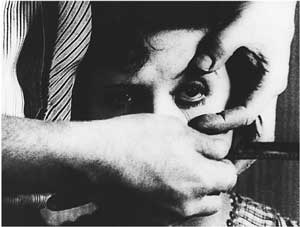 Yet
the film positions Bunuel in such a way that he precipitates the break between
Lorca and Dali and this is effective from a dramatic standpoint. Bunuel almost seems jealous that Dali designed the sets
for Lorca's play while Lorca neglects the film script that he had asked
him to write. Lorca doesn't want to leave Spain, while Bunuel tempts Dali
with stories of Paris. Dali's mind is made up when Lorca attempts to have
sex with him and he coldly announces that he is going to Paris to write
a film with Bunuel. Dali has also courted scandal by living openly with
Gala, a married woman who would become his lifelong muse. Leaving Lorca
heartbroken, Dali and Bunuel make Un Chien Andalu in Paris. A brief
montage of clips from the silent film follows, including the famous eyeball
slicing scene. The film's title translates as An Andalusion Dog and
Lorca perceives it as a personal attack. "Who else do they know,"
Lorca asks, "who comes from Andalu?" Yet
the film positions Bunuel in such a way that he precipitates the break between
Lorca and Dali and this is effective from a dramatic standpoint. Bunuel almost seems jealous that Dali designed the sets
for Lorca's play while Lorca neglects the film script that he had asked
him to write. Lorca doesn't want to leave Spain, while Bunuel tempts Dali
with stories of Paris. Dali's mind is made up when Lorca attempts to have
sex with him and he coldly announces that he is going to Paris to write
a film with Bunuel. Dali has also courted scandal by living openly with
Gala, a married woman who would become his lifelong muse. Leaving Lorca
heartbroken, Dali and Bunuel make Un Chien Andalu in Paris. A brief
montage of clips from the silent film follows, including the famous eyeball
slicing scene. The film's title translates as An Andalusion Dog and
Lorca perceives it as a personal attack. "Who else do they know,"
Lorca asks, "who comes from Andalu?" |
|
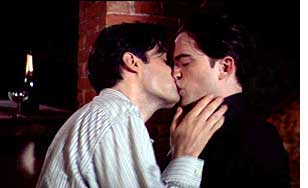 Their
love story is, in every way, a romantic tale from the initial courtship
through the betrayal. Perhaps if they met today they would have consummated
their love but Dali's penchant for iconoclasm, and his credo of "no limits,"
could not extend towards same sex physical love. Even Lorca wrestles with
his desires and tries to at least project an image of conventional heterosexuality.
But his heart belonged to Dali, as evidenced by his Ode To Dali and
the passionate letters they wrote to each other. Dali longs for Lorca as
well; he shyly responds to the poet's kisses and even initiates one himself
before succumbing to the era's gay panic. Their
love story is, in every way, a romantic tale from the initial courtship
through the betrayal. Perhaps if they met today they would have consummated
their love but Dali's penchant for iconoclasm, and his credo of "no limits,"
could not extend towards same sex physical love. Even Lorca wrestles with
his desires and tries to at least project an image of conventional heterosexuality.
But his heart belonged to Dali, as evidenced by his Ode To Dali and
the passionate letters they wrote to each other. Dali longs for Lorca as
well; he shyly responds to the poet's kisses and even initiates one himself
before succumbing to the era's gay panic. |
|
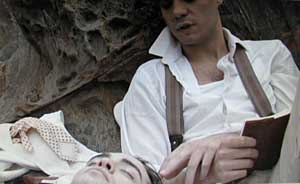 There
is no way of knowing for sure if Lorca and Dali actually consummated their
relationship but both men deeply loved each other - even if only on an artistic
plane. Little Ashes shares Munch's
The Hours And Times' conceit concerning
John Lennon and Brian Epstein; a fanciful but plausible fantasy. Passion
shared between like-minded artists is stronger than a physical attraction
and so the filmmakers are to be commended for treating their camaraderie
as a love story. Little Ashes
is quite romantic in spots, and also very erotic, but the pervading intellectualism
(demanded by the film's subjects) prevents the tale from ever truly catching
the fire that it should. There
is no way of knowing for sure if Lorca and Dali actually consummated their
relationship but both men deeply loved each other - even if only on an artistic
plane. Little Ashes shares Munch's
The Hours And Times' conceit concerning
John Lennon and Brian Epstein; a fanciful but plausible fantasy. Passion
shared between like-minded artists is stronger than a physical attraction
and so the filmmakers are to be commended for treating their camaraderie
as a love story. Little Ashes
is quite romantic in spots, and also very erotic, but the pervading intellectualism
(demanded by the film's subjects) prevents the tale from ever truly catching
the fire that it should. |
|
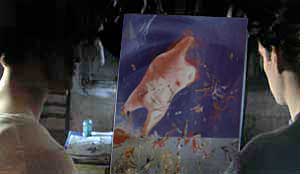 Little
Ashes
is a very handsome production and great pains have been taken to reproduce
the period. The filmmakers have nailed most of the historical details; the
appropriate canvasses by Dali, for example, are spotlighted - the correct
one even hangs over Lorca's bed. Archival photographs are re-created. Newsreel
footage is employed. When Franco's soldiers execute Lorca, one notes that
he is still alive and declares that "there is only one to kill a fag." The
last gunshot occurs off camera but those familiar with the legends surrounding
the poet's death will be reminded of the rumors that Lorca received a final
bullet up his rectum. Little
Ashes
is a very handsome production and great pains have been taken to reproduce
the period. The filmmakers have nailed most of the historical details; the
appropriate canvasses by Dali, for example, are spotlighted - the correct
one even hangs over Lorca's bed. Archival photographs are re-created. Newsreel
footage is employed. When Franco's soldiers execute Lorca, one notes that
he is still alive and declares that "there is only one to kill a fag." The
last gunshot occurs off camera but those familiar with the legends surrounding
the poet's death will be reminded of the rumors that Lorca received a final
bullet up his rectum. |
|
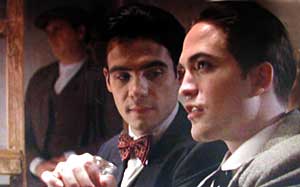 Movies
about the friendships - and rivalries - between artists are hard to pull
off. Amadeus did it admirably while Total Eclipse, despite
the talent involved, was a complete train wreck.
Little Ashes doesn't quite achieve greatness but it is far
from being a train wreck. Those unfamiliar with the players might find the
film hard to understand but Little Ashes
has many pleasures for those who are willing to take the plunge. Movies
about the friendships - and rivalries - between artists are hard to pull
off. Amadeus did it admirably while Total Eclipse, despite
the talent involved, was a complete train wreck.
Little Ashes doesn't quite achieve greatness but it is far
from being a train wreck. Those unfamiliar with the players might find the
film hard to understand but Little Ashes
has many pleasures for those who are willing to take the plunge. |
|
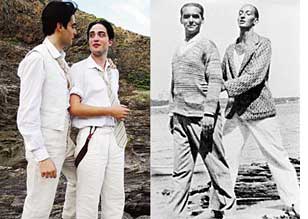 Despite
the presence of Pattinson, Little Ashes
did not find a mass audience. I suppose it is too much to hope that the
legions of teen-aged girls (and horny gay adolescent boys) who flock to
the Twilight movies might check out this film and learn a little
bit about art and literature. It's worth noting that Beltran (Lorca) is
also a heartthrob in Spain, and that the two of them do light up
the screen from time to time. Even if Little
Ashes isn't quite the masterful historical fantasia that
Amadeus was, there is much to admire in Little
Ashes and it comes recommended. Despite flaws, it is a well
directed film, exquisitely shot, and nicely acted. As a bonus, we get a
heallthy dose of Lorca's poetry and Dali's art. It's anything but a dry
history lesson. Despite
the presence of Pattinson, Little Ashes
did not find a mass audience. I suppose it is too much to hope that the
legions of teen-aged girls (and horny gay adolescent boys) who flock to
the Twilight movies might check out this film and learn a little
bit about art and literature. It's worth noting that Beltran (Lorca) is
also a heartthrob in Spain, and that the two of them do light up
the screen from time to time. Even if Little
Ashes isn't quite the masterful historical fantasia that
Amadeus was, there is much to admire in Little
Ashes and it comes recommended. Despite flaws, it is a well
directed film, exquisitely shot, and nicely acted. As a bonus, we get a
heallthy dose of Lorca's poetry and Dali's art. It's anything but a dry
history lesson. |
 Lorca,
a legend in Spain, is revered as both a poet and as a dramatist. His plays,
steeped in Andalusian folklore, include Blood Wedding (1932) and
The House of Bernarda Alba (1936). When the Spanish Civil War exploded
in 1936, Lorca was arrested by members of General Francisco Franco's Nationalist
Party because of his politics (many historians claim that his homosexuality
had something to do with it as well). A few days later, he was assassinated.
His works were banned until the 1950s.
Lorca,
a legend in Spain, is revered as both a poet and as a dramatist. His plays,
steeped in Andalusian folklore, include Blood Wedding (1932) and
The House of Bernarda Alba (1936). When the Spanish Civil War exploded
in 1936, Lorca was arrested by members of General Francisco Franco's Nationalist
Party because of his politics (many historians claim that his homosexuality
had something to do with it as well). A few days later, he was assassinated.
His works were banned until the 1950s.