
GAY
FILM REVIEWS BY MICHAEL D. KLEMM


|
||||||
|
GAY
FILM REVIEWS BY MICHAEL D. KLEMM
|
||||||
|
|
|
|
|
|
|
|
The
Witnesses Strand
Releasing, Director: Screenplay: Starring: Unrated, 112 minutes
A
Year Without Love Director: Screenplay: Starring Unrated, 95 minutes |
Journal
Of the
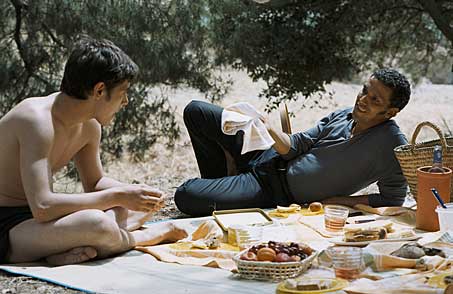
In 1994, French director Andre Techine fathered a delightful film entitled Wild Reeds; a microcosm of the French-Algerian conflict told through the sexual awakenings (both gay and straight) of a small circle of students. Wild Reeds was a film of great lyrical beauty on par with the best of Truffaut. Techine's newest film, The Witnesses, is set during another period of great upheaval. The year is 1984 and the setting is Paris. It is a carefree time; a sexual revolution is in full bloom. The Witnesses chronicles the connections between a group of friends whose lives are thrown into a tailspin when a "mysterious disease from the West" rears its ugly head. |
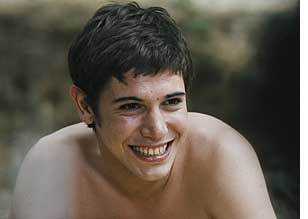 Manu
(Johan Libereau) is a cute young boytoy who has just come to Paris to live
with his sister, Julie (Julie Depardieu). She is an aspiring opera singer
who resides in a seedy hotel. Greeting her brother, she remarks that he
is "as narcissistic as ever." Later, strolling through a gay cruising park,
Manu meets Adrien, (Michel Blanc), a 50-ish doctor. Manu thinks Adrien is
too old and seeks out fresher meat, but then imposes on the doctor to guard
his coat while he goes trysting in the trees. Adrien is smitten by the impulsive
young lad and his willingness to trust him. He takes Manu under his wing,
wining and dining him and showing him the sights of Paris. Manu
(Johan Libereau) is a cute young boytoy who has just come to Paris to live
with his sister, Julie (Julie Depardieu). She is an aspiring opera singer
who resides in a seedy hotel. Greeting her brother, she remarks that he
is "as narcissistic as ever." Later, strolling through a gay cruising park,
Manu meets Adrien, (Michel Blanc), a 50-ish doctor. Manu thinks Adrien is
too old and seeks out fresher meat, but then imposes on the doctor to guard
his coat while he goes trysting in the trees. Adrien is smitten by the impulsive
young lad and his willingness to trust him. He takes Manu under his wing,
wining and dining him and showing him the sights of Paris. |
|
|
|
|
|
|
|
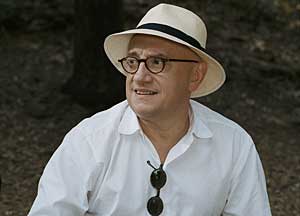 This
is an amazing ensemble film, juggling multiple characters and storylines
while dramatizing the confusion and terror manifest during the early days
of the AIDS pandemic. This was a time that young audiences, half my age,
didn't live through... when almost nothing was known about the disease and
those who developed full-blown AIDS often died within months of their diagnosis.
Manu's illness will have far-reaching repercussions for each of the principals.
Adrien, who has already been studying this new disease with a coalition
of other doctors, becomes Manu's physician and caregiver, while Mehdi fears
that he is also infected and may have also given the virus to his wife. This
is an amazing ensemble film, juggling multiple characters and storylines
while dramatizing the confusion and terror manifest during the early days
of the AIDS pandemic. This was a time that young audiences, half my age,
didn't live through... when almost nothing was known about the disease and
those who developed full-blown AIDS often died within months of their diagnosis.
Manu's illness will have far-reaching repercussions for each of the principals.
Adrien, who has already been studying this new disease with a coalition
of other doctors, becomes Manu's physician and caregiver, while Mehdi fears
that he is also infected and may have also given the virus to his wife.
|
|
|
Before you say that this sounds depressingly familiar, The Witnesses doesn't follow the standard formula of most past AIDS films. The emphasis here is not on the suffering and eventual death of one protagonist, nor is it about a collection of identifiable types (the slut, the cuckolded lover, the gym rat, the showtune queen) who all succumb, one by one, to the virus. Techine eschews operatic excess in favor of quiet character-driven drama and The Witnesses has great characters in abundance. |
|
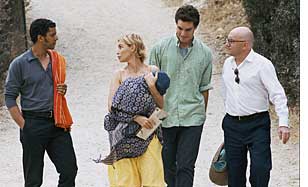 Life
is never black and white; humans are a mass of contradictions and it is
a joy to sometimes actually see this depicted believably in the movies.
Take, for example, Sarah who writes children's books but wishes she never
had a child. Obsessed with finishing her new novel, she wears earplugs as
she types so that she doesn't hear the baby crying. Her husband, Mehdi,
is a star player with the vice squad. Primarily targeting prostitution,
he is not above raiding the gay bars and cruising parks. A punkish hooker,
who lives in the same flophouse as Manu and his sister, calls Mehdi " a
man on a mission." Even so, he falls under Manu's spell, enjoying daily
trysts and sometimes even bottoming for the young Casanova. Mehdi
enjoys an open relationship with Sarah, who doesn't care who he sleeps
with, as long as she can work on her book. But, if he has been infected
by his assignations with Manu, how is he going to explain this, not just
to his wife, but also to his fellow vice cops? Life
is never black and white; humans are a mass of contradictions and it is
a joy to sometimes actually see this depicted believably in the movies.
Take, for example, Sarah who writes children's books but wishes she never
had a child. Obsessed with finishing her new novel, she wears earplugs as
she types so that she doesn't hear the baby crying. Her husband, Mehdi,
is a star player with the vice squad. Primarily targeting prostitution,
he is not above raiding the gay bars and cruising parks. A punkish hooker,
who lives in the same flophouse as Manu and his sister, calls Mehdi " a
man on a mission." Even so, he falls under Manu's spell, enjoying daily
trysts and sometimes even bottoming for the young Casanova. Mehdi
enjoys an open relationship with Sarah, who doesn't care who he sleeps
with, as long as she can work on her book. But, if he has been infected
by his assignations with Manu, how is he going to explain this, not just
to his wife, but also to his fellow vice cops? |
|
 The
first act, subtitled: Happy Days, Summer 1984, ebbs into act two:
War, Winter 1984-5 and the sunny opening hour contrasts with the
tragic second half. Dark comedy co-exists with the drama and no story arc,
not even Manu's illness, is milked for pathos. In fact, many of the big
moments, as when Manu learns of his condition, are often dispensed with
by a few lines of Sarah's ironic narration (which may or may not be from
the book she is writing.). The script is a marvel. My only criticism might
be that it goes on for a bit too long at the end without a good bang, as
Salieri would describe to Mozart in Amadeus, to let the audience
know when to clap. But a true artist like Mozart trusts his audience. I
think that was the filmmakers' intention; to show how life goes on and that
the loose strands are never tied up with a big red bow. The
first act, subtitled: Happy Days, Summer 1984, ebbs into act two:
War, Winter 1984-5 and the sunny opening hour contrasts with the
tragic second half. Dark comedy co-exists with the drama and no story arc,
not even Manu's illness, is milked for pathos. In fact, many of the big
moments, as when Manu learns of his condition, are often dispensed with
by a few lines of Sarah's ironic narration (which may or may not be from
the book she is writing.). The script is a marvel. My only criticism might
be that it goes on for a bit too long at the end without a good bang, as
Salieri would describe to Mozart in Amadeus, to let the audience
know when to clap. But a true artist like Mozart trusts his audience. I
think that was the filmmakers' intention; to show how life goes on and that
the loose strands are never tied up with a big red bow. |
|
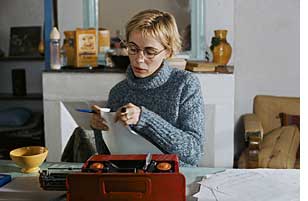 The
acting by all is superb. Special praise to Michel Blanc, who beautifully
embodies Adrien's tragedy without becoming pathetic or maudlin. Played as
a cross between Felix Unger and Donald Pleasance, he is noble and flawed,
wise and deluded, and an utterly compelling character. Johan Libereau, as
Manu, is adorable without being boy-band-cute. His wide-eyed innocence is
infectious. He is a young man who, in many ways, is still a boy and this
makes his fate all the more tragic. He recalls how he never bruised when
he got beat up in school, and now he is helpless and dying of a disease
that he has never even heard of before now. Emmanuelle Beart is both
icy and manic as Sarah. Sami Bouajila's Mehdi is testosterone incarnate
and made of stone, but vulnerable beneath in a way not unlike Brando in
A Streetcar Named Desire. One of the film's best moments is reserved
for him when he learns of Manu's illness, breaks down the moment he is alone,
and then sits in a laundromat and stares, in a Zen-like trance, at the tumbling
clothes in a washing machine's window. The
acting by all is superb. Special praise to Michel Blanc, who beautifully
embodies Adrien's tragedy without becoming pathetic or maudlin. Played as
a cross between Felix Unger and Donald Pleasance, he is noble and flawed,
wise and deluded, and an utterly compelling character. Johan Libereau, as
Manu, is adorable without being boy-band-cute. His wide-eyed innocence is
infectious. He is a young man who, in many ways, is still a boy and this
makes his fate all the more tragic. He recalls how he never bruised when
he got beat up in school, and now he is helpless and dying of a disease
that he has never even heard of before now. Emmanuelle Beart is both
icy and manic as Sarah. Sami Bouajila's Mehdi is testosterone incarnate
and made of stone, but vulnerable beneath in a way not unlike Brando in
A Streetcar Named Desire. One of the film's best moments is reserved
for him when he learns of Manu's illness, breaks down the moment he is alone,
and then sits in a laundromat and stares, in a Zen-like trance, at the tumbling
clothes in a washing machine's window. |
|
|
After spending the
last year mired in mediocre movies, The Witnesses
(and a few others like The Bubble and
Go West) has restored my faith in queer
cinema. This one would have been at home in one my college film classes.
This is one of the finest films, gay or straight, that I have seen in
a long time.
|
|
 |
|
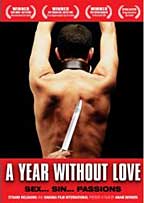
| A recent Spanish import, entitled A Year Without Love, is another film of considerable merit. Based on a memoir published by poet Pablo Perez, first-time director Anahi Berneri's edgy film adaptation, set in 1996 Buenos Aires, adds an unusual spin to what could have been just another tug-at-the-heartstrings AIDS drama. Juan Minujin plays Pablo, a young poet who has tested positive and is starting to get sick. He refuses his AZT medication, telling his doctor that "I won't play guinea pig for you while you try to get the right dose." Believing that his days are few, he begins keeping a journal. He also continues to live his life, placing personal ads in magazines and cruising the early internet. Thumbing his nose at his illness, he throws on a leather jacket one night and goes out to the bars even though, moments before, he lay coughing in his bed. | |
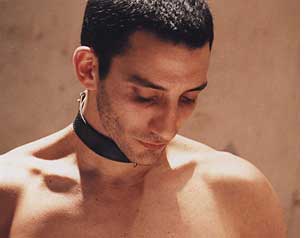 Online
assignations lead to a meeting with "Leather couple seeks threesome." Pablo
becomes the guest of the Sheriff, a major player in the local S&M scene.
Our young poet explains that he has had some experience in the leather bars
of Paris when he lived abroad. Family matters forced his return to Buenos
Aires; he left a lover behind and wasn't in Paris when he died. Guilt-ridden,
aching for love and scared of dying, he submits to the Sheriff; accepting
the lash across his back as he learns to eroticize his pain. Online
assignations lead to a meeting with "Leather couple seeks threesome." Pablo
becomes the guest of the Sheriff, a major player in the local S&M scene.
Our young poet explains that he has had some experience in the leather bars
of Paris when he lived abroad. Family matters forced his return to Buenos
Aires; he left a lover behind and wasn't in Paris when he died. Guilt-ridden,
aching for love and scared of dying, he submits to the Sheriff; accepting
the lash across his back as he learns to eroticize his pain. |
|
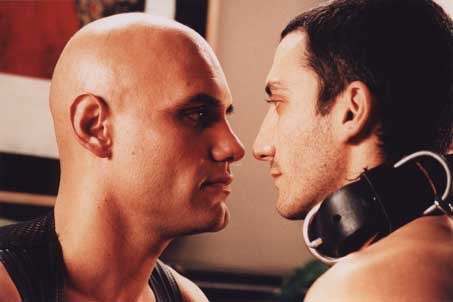
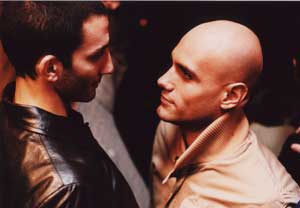 Pablo's
odyssey is a dark story, leavened here and there with bits of humor. There
are hints at a possible love story; Pablo falls for a hot young leather
master, with a shaved head, named Martin (Javier van de Couter). It's hard
to tell if the feeling is mutual beyond the intense sexual attraction, established
in two early scenes, when the men made eye contact as they pass in the entrance
to a gay bar and later on the street outside the Sheriff's apartment building.
Their first tryst is rather romantic, their second involves flogging. Pablo's
odyssey is a dark story, leavened here and there with bits of humor. There
are hints at a possible love story; Pablo falls for a hot young leather
master, with a shaved head, named Martin (Javier van de Couter). It's hard
to tell if the feeling is mutual beyond the intense sexual attraction, established
in two early scenes, when the men made eye contact as they pass in the entrance
to a gay bar and later on the street outside the Sheriff's apartment building.
Their first tryst is rather romantic, their second involves flogging. |
|
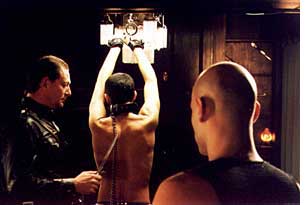 This
concept will be alien to many viewers. An open mind is essential because
the leather and bondage scenes, as depicted here, are quite explicit. They
aren't, however, exploitative. This isn't porn but it's also definitely
not for the prudish or squeamish. One scene, in particular, is both erotic
and terrifying at once. Designed for mature audiences, this is not a television
"disease of the week" flick. This is also a film that would never get green-lighted
in Hollywood - where it is acceptable to have carnal relations with an apple
pie but a male love story is still considered box office poison (despite
the success of Brokeback
Mountain). What I found the most interesting about A
Year Without Love was the way that the S&M world was not,
for a change, depicted as a criminal underworld (8MM) menacing (Cruising),
or played for laughs (Exit to Eden) as it usually is in most films,
straight and gay. This
concept will be alien to many viewers. An open mind is essential because
the leather and bondage scenes, as depicted here, are quite explicit. They
aren't, however, exploitative. This isn't porn but it's also definitely
not for the prudish or squeamish. One scene, in particular, is both erotic
and terrifying at once. Designed for mature audiences, this is not a television
"disease of the week" flick. This is also a film that would never get green-lighted
in Hollywood - where it is acceptable to have carnal relations with an apple
pie but a male love story is still considered box office poison (despite
the success of Brokeback
Mountain). What I found the most interesting about A
Year Without Love was the way that the S&M world was not,
for a change, depicted as a criminal underworld (8MM) menacing (Cruising),
or played for laughs (Exit to Eden) as it usually is in most films,
straight and gay. |
|
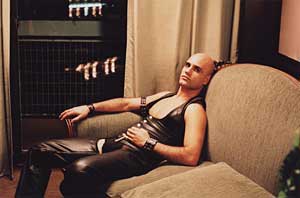 A
full portrait of the artist greets the audience. We learn that, as a boy,
he began to write by pretending that he was the ghost of famed Chilean poet,
Pablo Nerudo, when he and his aunt played with a Ouija board. He shares
a flat with the same aunt, now senile, the rent is paid by his indifferent
father and, to make ends meet, Pablo tutors students in French. We meet
Pablo's best friend, we meet his doctors, several very friendly leather
men, an amorous female pupil, and his publisher - who sees more commercial
potential in a diary of Pablo's illness than a volume of his poetry. Small
character touches abound, like his aunt amusedly flipping through one of
his porn magazines when he's not looking, or super leather stud Martin still
living at home with his parents. A
full portrait of the artist greets the audience. We learn that, as a boy,
he began to write by pretending that he was the ghost of famed Chilean poet,
Pablo Nerudo, when he and his aunt played with a Ouija board. He shares
a flat with the same aunt, now senile, the rent is paid by his indifferent
father and, to make ends meet, Pablo tutors students in French. We meet
Pablo's best friend, we meet his doctors, several very friendly leather
men, an amorous female pupil, and his publisher - who sees more commercial
potential in a diary of Pablo's illness than a volume of his poetry. Small
character touches abound, like his aunt amusedly flipping through one of
his porn magazines when he's not looking, or super leather stud Martin still
living at home with his parents. |
|
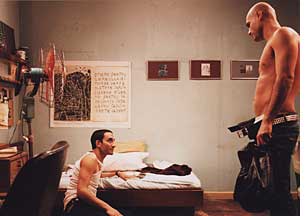 A
keen eye for the image is at work here. Many visual parallels are drawn,
contrasting the bondage settings with hospital examinations. A close-up
of an arm penetrated by a needle, and an X-ray grid projected onto Pablo's
bare back, will look just as creepy to some as the poster art's dagger caressing
that same flesh. The hospital scenes are sterile, drained of all color while
a dark S&M orgy, glimpsed in brief flashes, is warm, womblike and mysterious. A
keen eye for the image is at work here. Many visual parallels are drawn,
contrasting the bondage settings with hospital examinations. A close-up
of an arm penetrated by a needle, and an X-ray grid projected onto Pablo's
bare back, will look just as creepy to some as the poster art's dagger caressing
that same flesh. The hospital scenes are sterile, drained of all color while
a dark S&M orgy, glimpsed in brief flashes, is warm, womblike and mysterious. |
|
| Though A Year Without Love is not without its flaws, it remains compelling cinema. Pablo eventually submits to the new AIDS cocktails and responds to the treatment but family strife provides a bit of third act drama before the film comes to a very abrupt conclusion. Reportedly, the ending (or lack thereof) mirrors author Perez's diary, that ended as the year did, but a bit of a cinematic coda - even a freeze frame of Pablo's face or perhaps a title card to announce that this was based on a true story - would have provided dessert to a heavy meal. | |
|
More
on Andre Techine: Carlos Echevarria also appears in: |
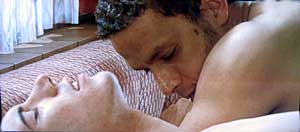
 But
it is a sexless relationship, and one that the good doctor, at first,
accepts in stride. Manu loves Adrien, in his own way, but refuses his
invitation to move in; preferring to live in the flophouse with his sister
(and have lots of sex on the side) while still enjoying the adoring doctor's
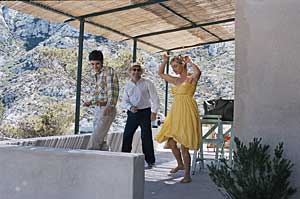
generosity. The curtain will rise on a new drama when they spend the weekend
with Adrien's closest friend, Sarah (Emmanuelle Beart), her husband Mehdi
(Sam Bouajila), and their newborn child at a spacious house on the seaside.
Sarah is a writer of children's books who has recently discovered that
she despises motherhood, and Mehdi is a vice cop who has assumed all the
duties of raising their child. Mehdi will make a discovery of his own
that weekend when he saves Manu from drowning. The ensuing rescue scene
is heroic and maybe just a bit erotic. He finds that he is attracted to
the lad, even though he doesn't identify as gay, and the two men embark
on a passionate affair.
But
it is a sexless relationship, and one that the good doctor, at first,
accepts in stride. Manu loves Adrien, in his own way, but refuses his
invitation to move in; preferring to live in the flophouse with his sister
(and have lots of sex on the side) while still enjoying the adoring doctor's
generosity. The curtain will rise on a new drama when they spend the weekend
with Adrien's closest friend, Sarah (Emmanuelle Beart), her husband Mehdi
(Sam Bouajila), and their newborn child at a spacious house on the seaside.
Sarah is a writer of children's books who has recently discovered that
she despises motherhood, and Mehdi is a vice cop who has assumed all the
duties of raising their child. Mehdi will make a discovery of his own
that weekend when he saves Manu from drowning. The ensuing rescue scene
is heroic and maybe just a bit erotic. He finds that he is attracted to
the lad, even though he doesn't identify as gay, and the two men embark
on a passionate affair.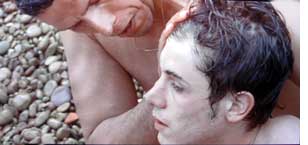 Adrien
remains unaware that his beloved is sleeping with his best friend's husband
but he is, nevertheless, getting tired of being treated like a doormat.
"I can't play the spurned lover over a guy who isn't my lover," he tells
Sarah one day. "Masochism has its limits." When he does learn the
truth he is furious, but he finds himself on the horns of yet another
dilemma when he recognizes Karposi Sarcoma lesions on Manu's chest. Witnessing
the horrified look on the doctor's face, Manu innocently asks, "What's
up? I haven't got the plague."
Adrien
remains unaware that his beloved is sleeping with his best friend's husband
but he is, nevertheless, getting tired of being treated like a doormat.
"I can't play the spurned lover over a guy who isn't my lover," he tells
Sarah one day. "Masochism has its limits." When he does learn the
truth he is furious, but he finds himself on the horns of yet another
dilemma when he recognizes Karposi Sarcoma lesions on Manu's chest. Witnessing
the horrified look on the doctor's face, Manu innocently asks, "What's
up? I haven't got the plague."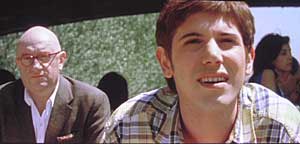 The
cinematography is also splendid. Techine uses the Cinemascope wide screen
as a canvas, offering painterly compositions as food for the brain. If
a picture is worth a thousand words, as they say; look at the screen capture
(at right) of Adrien and Manu from an early scene. Adrien is sharing his
world with his young protege, but the camera captures their separateness.
Adrien sits in the seat directly behind Manu but see how far apart they
seem from each other because of the camera's placement. Techine also has
fun channeling Godard with jump cuts ala Breathless. Like Truffaut
and the other French New Wave directors from the 1960s, Techine also wrote
for the legendary film journal Cahiers du Cinema, (though many
years later), before moving behind the camera himself and it's clear that
he learned much from the masters.
The
cinematography is also splendid. Techine uses the Cinemascope wide screen
as a canvas, offering painterly compositions as food for the brain. If
a picture is worth a thousand words, as they say; look at the screen capture
(at right) of Adrien and Manu from an early scene. Adrien is sharing his
world with his young protege, but the camera captures their separateness.
Adrien sits in the seat directly behind Manu but see how far apart they
seem from each other because of the camera's placement. Techine also has
fun channeling Godard with jump cuts ala Breathless. Like Truffaut
and the other French New Wave directors from the 1960s, Techine also wrote
for the legendary film journal Cahiers du Cinema, (though many
years later), before moving behind the camera himself and it's clear that
he learned much from the masters. 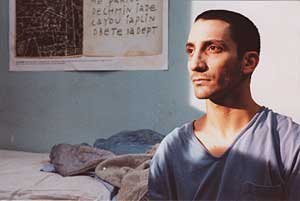 This
film is not for everyone. Many will, no doubt, be weirded out by Pablo's
journey while others will accept his approach to sexual healing. Pablo
is an attractive and likable lead; an everyman in dire straits, grasping
for any opportunity to be happy. If his path is an unconventional one,
so be it. The movie makes no judgments and asks that we do the same. Not
recommended as a fun date movie (unless both parties are students of Ingmar
Bergman) but adventurous audiences will find their synapses stimulated.
This
film is not for everyone. Many will, no doubt, be weirded out by Pablo's
journey while others will accept his approach to sexual healing. Pablo
is an attractive and likable lead; an everyman in dire straits, grasping
for any opportunity to be happy. If his path is an unconventional one,
so be it. The movie makes no judgments and asks that we do the same. Not
recommended as a fun date movie (unless both parties are students of Ingmar
Bergman) but adventurous audiences will find their synapses stimulated.