
GAY
FILM REVIEWS BY MICHAEL D. KLEMM


|
||||||
|
GAY
FILM REVIEWS BY MICHAEL D. KLEMM
|
||||||
|
|
|
|
|
|
|
|
The Naked Civil Servant BBC Video, Director: Screenplay: Starring: Unrated, 87 minutes
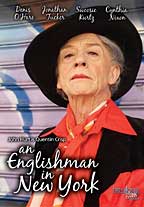
An Englishman in New York Breaking
Glass Pictures / QC Cinema, Director: Screenplay: Starring: Unrated, 75 minutes
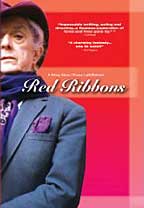
Red Ribbons Waterbearer Films, Director/Screenplay: Starring: Unrated, 64 minutes |
To
The Beat Of A Different Drummer
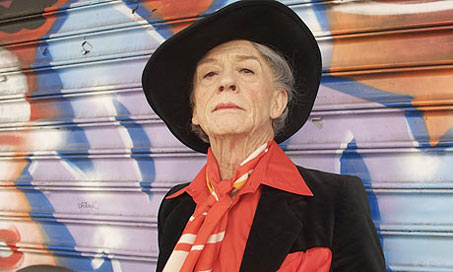
Savoring every moment of a truly outstanding acting performance is one of life's great pleasures. I'm talking about when an actor completely becomes the character he or she is playing and you can't take your eyes from the performer. I'm talking Gary Oldman as Joe Orton in Prick Up Your Ears; Derek Jacobi in I, Claudius; Ian McKellen in Richard III; John Lithgow's recent stint as a serial killer on Dexter. John Hurt's outrageous, yet perceptive and sensitive, portrayal of Quentin Crisp in The Naked Civil Servant (1975) falls under this umbrella. As a gift to audiences everywhere, Hurt has just reprised the role of Crisp - as an old man - in 2009's An Englishman in New York. |
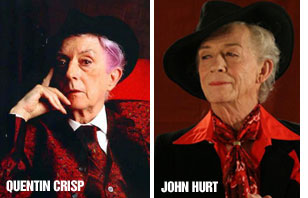 The
Naked Civil Servant is
based on the 1968 autobiography by Quentin Crisp. An
Englishman in New York, titled after the song by Sting (written
for Crisp), draws from many sources to depict Crisp's twilight celebrity
life in America. The new film doesn't shy away from depicting a major controversy
and this will be discussed later. This review examines both of these films
in their proper sequence. An Englishman in New
York is the new release but the narrative arc will be better
if we begin with The Naked Civil Servant. The
Naked Civil Servant is
based on the 1968 autobiography by Quentin Crisp. An
Englishman in New York, titled after the song by Sting (written
for Crisp), draws from many sources to depict Crisp's twilight celebrity
life in America. The new film doesn't shy away from depicting a major controversy
and this will be discussed later. This review examines both of these films
in their proper sequence. An Englishman in New
York is the new release but the narrative arc will be better
if we begin with The Naked Civil Servant.
|
|
|
|
|
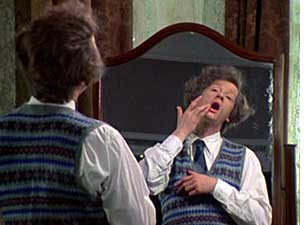 The
Naked Civil Servant,
made for British television in 1975, is a remarkable mix of high camp and
pathos. Its achievement is extraordinary, especially when one considers
how astonishingly un-apologetic it is for a movie filmed during the 1970s.
Need I mention how queers were being depicted on America's screens, big
and small? The film's approach is often as iconoclastic as its subject and
rich with humor. Swinging big band standards from the period keeps the mood
lively. The narrations are both fabulous and dark with irony. These are
augmented, usually for comic effect, by silent film title cards. Framed
by an ornate Art Nouveau border are such epithets as "Sexual intercourse
is a poor substitute for masturbation" and "Exhibitionism is a drug. You
get hooked." The
Naked Civil Servant,
made for British television in 1975, is a remarkable mix of high camp and
pathos. Its achievement is extraordinary, especially when one considers
how astonishingly un-apologetic it is for a movie filmed during the 1970s.
Need I mention how queers were being depicted on America's screens, big
and small? The film's approach is often as iconoclastic as its subject and
rich with humor. Swinging big band standards from the period keeps the mood
lively. The narrations are both fabulous and dark with irony. These are
augmented, usually for comic effect, by silent film title cards. Framed
by an ornate Art Nouveau border are such epithets as "Sexual intercourse
is a poor substitute for masturbation" and "Exhibitionism is a drug. You
get hooked." |
|
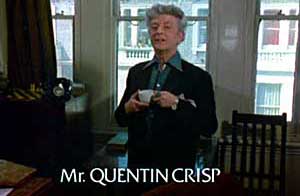 Director
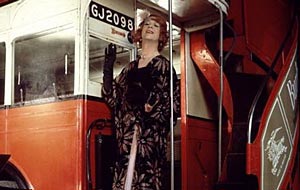
Jack Gold wisely opens his film with an introduction by the real Quentin
Crisp in all his queenly glory. This was a good thing because otherwise
the average viewer might assume that John Hurt must be exaggerating
his performance. The first time we see him he is posing in front of a full
length mirror. His stuffy father enters and snips, "Do you intend to spend
your entire life admiring yourself?" His son replies, "If I possibly can." Director
Jack Gold wisely opens his film with an introduction by the real Quentin
Crisp in all his queenly glory. This was a good thing because otherwise
the average viewer might assume that John Hurt must be exaggerating
his performance. The first time we see him he is posing in front of a full
length mirror. His stuffy father enters and snips, "Do you intend to spend
your entire life admiring yourself?" His son replies, "If I possibly can."
|
|
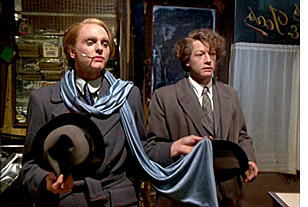 Philip
Mackie's script captures the man's acerbic wit and Hurt brings Crisp vividly
to life. He is exotic. He is so alien and so weird that audiences
won't feel threatened; you can't help but embrace him. Holding his head
high, he sashays through the streets, ignoring the stares and the insults.
He knows what he is doing and it is his middle finger extended out at the
world. His attitude invites admiration. When Crisp is stopped by the police
and called a pansy, he replies, "I don't know any other meaning of this
word apart from being a flower." The other world, he tells a friend, is
something he doesn't wish to join. When war is declared in 1939, he buys
two pounds of Henna. There is a truly ugly moment when he is beat up by
a group of thugs (recalling a similar scene in A Clockwork Orange)
but, retaining his dignity, he rises bloodied to ask "Have I annoyed you
gentlemen in some way?" Philip
Mackie's script captures the man's acerbic wit and Hurt brings Crisp vividly
to life. He is exotic. He is so alien and so weird that audiences
won't feel threatened; you can't help but embrace him. Holding his head
high, he sashays through the streets, ignoring the stares and the insults.
He knows what he is doing and it is his middle finger extended out at the
world. His attitude invites admiration. When Crisp is stopped by the police
and called a pansy, he replies, "I don't know any other meaning of this
word apart from being a flower." The other world, he tells a friend, is
something he doesn't wish to join. When war is declared in 1939, he buys
two pounds of Henna. There is a truly ugly moment when he is beat up by
a group of thugs (recalling a similar scene in A Clockwork Orange)
but, retaining his dignity, he rises bloodied to ask "Have I annoyed you
gentlemen in some way?" |
|
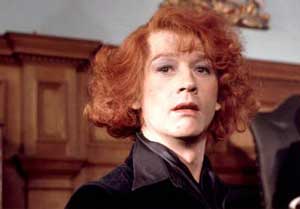 Poor
Quentin doesn't fit in anywhere. He even experiences homophobia from his
own kind when he is asked to leave a gay establishment because he would
give all of them away to the police by being so obvious. But that
was Mr. Crisp's specialty. He didn't care what anyone thought. There is
a marvelous scene in which he appears in court on trumped up indecency charges.
When asked if he would like to make his statement from the docks or take
the witness box, his voice-over announces that he "can't possibly play [his]
big scene with [his] back to the audience." He speaks with such dignity
in his defense that he is able to make a political statement while still
winning the courtroom's hearts. Poor
Quentin doesn't fit in anywhere. He even experiences homophobia from his
own kind when he is asked to leave a gay establishment because he would
give all of them away to the police by being so obvious. But that
was Mr. Crisp's specialty. He didn't care what anyone thought. There is
a marvelous scene in which he appears in court on trumped up indecency charges.
When asked if he would like to make his statement from the docks or take
the witness box, his voice-over announces that he "can't possibly play [his]
big scene with [his] back to the audience." He speaks with such dignity
in his defense that he is able to make a political statement while still
winning the courtroom's hearts. |
|
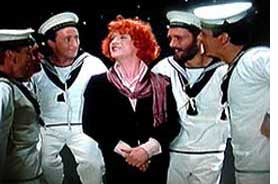 Vito
Russo wrote in The Celluloid
Closet that Crisp was not a gay liberationist's dream but conceded
that you had to admire the man's courage. The
Naked Civil Servant was well received critically and Hurt
won a BAFTA award for his starring role. There was controversy too, (did
you expect otherwise?), especially when PBS aired it in America. The film
brought the real Mr. Crisp his fifteen minutes of fame and this part of
his life would be dramatized thirty-three years later in the new film, An
Englishman in New York. Vito
Russo wrote in The Celluloid
Closet that Crisp was not a gay liberationist's dream but conceded
that you had to admire the man's courage. The
Naked Civil Servant was well received critically and Hurt
won a BAFTA award for his starring role. There was controversy too, (did
you expect otherwise?), especially when PBS aired it in America. The film
brought the real Mr. Crisp his fifteen minutes of fame and this part of
his life would be dramatized thirty-three years later in the new film, An
Englishman in New York. |
|
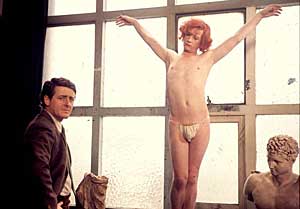 You
will be seriously charmed by Hurt's delightfully fey portrayal in both films.
There is one unforgettable scene after another. A man pulls him into an
alley for a quickie ("The great thing about following an obvious homosexual
is that you can't possibly be wrong"). Witness his joy when he meets more
of his kind for the first time in the Black Cat Cafe. One of his new friends
gives Crisp a tube of lipstick which he rapturously accepts. He works as
a nude model for an art class (hence the film's title). He enjoys a lot
of sex with soldiers during the war. For a brief time he dabbles in the
world's oldest profession. At a tea party, he so shocks his mother's friend
that she gasps, "Oh dear, your son isn't one of those, is he?" You
will be seriously charmed by Hurt's delightfully fey portrayal in both films.
There is one unforgettable scene after another. A man pulls him into an
alley for a quickie ("The great thing about following an obvious homosexual
is that you can't possibly be wrong"). Witness his joy when he meets more
of his kind for the first time in the Black Cat Cafe. One of his new friends
gives Crisp a tube of lipstick which he rapturously accepts. He works as
a nude model for an art class (hence the film's title). He enjoys a lot
of sex with soldiers during the war. For a brief time he dabbles in the
world's oldest profession. At a tea party, he so shocks his mother's friend
that she gasps, "Oh dear, your son isn't one of those, is he?" |
|
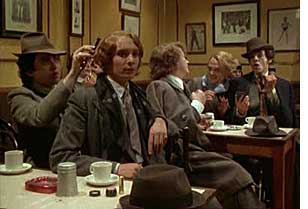 Hurt
is one of our most distinguished living character actors. He literally disappears
into his performance as Crisp. In lesser hands, Crisp could have been a
cartoon. You laugh with him and not at him. Hurt doesn't
hold back on the foppery but he also finds the humanity beneath. Despite
his appearance, he stands his ground with dignity and there is great strength
behind the makeup. His face, even as a young man, is a roadmap of emotions.
He skillfully makes the outlandish plausible. He's a Kabuki dandy interpreted
with grace and subtlety. Quentin Crisp was the role that Hurt was born to
play. Hurt
is one of our most distinguished living character actors. He literally disappears
into his performance as Crisp. In lesser hands, Crisp could have been a
cartoon. You laugh with him and not at him. Hurt doesn't
hold back on the foppery but he also finds the humanity beneath. Despite
his appearance, he stands his ground with dignity and there is great strength
behind the makeup. His face, even as a young man, is a roadmap of emotions.
He skillfully makes the outlandish plausible. He's a Kabuki dandy interpreted
with grace and subtlety. Quentin Crisp was the role that Hurt was born to
play. |
|
|
|
|
 |
|
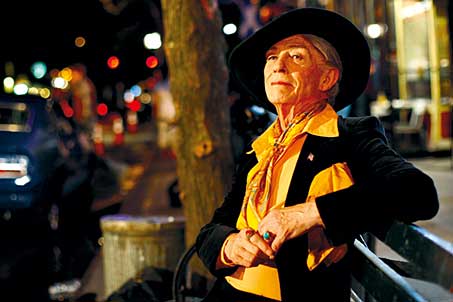
| It would be hard to imagine this movie without Hurt. The same is true for its sequel, An Englishman In New York. The new movie, directed by Richard Laxton from a screenplay by Brian Fillis, begins almost where the first one left off, with Crisp suddenly finding himself in demand on talk shows following the release of The Naked Civil Servant film. Crisp's wit, if anything has gotten better with age. "All my newfound celebrity meant was that my tormentors could put a name to their demon." Crisp tells us when he receives a phone call from a man threatening to assault him. "Would you like to make an appointment? Crisp, deadpan, replies to be his would-be assailant, "I have some time on Tuesday afternoon if that's convenient." | |
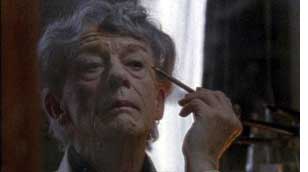 Crisp
is invited to America to perform in a one man show and, in 1981, establishes
permanent residence in New York City. During these shows he regales the
audience with stories of his life and then delights them further by taking
questions. The show is a hit. He acquires an agent, played by Swoosie Kurtz.
"You're different," she tells Crisp. "People like different." She lands
him a gig writing movie reviews for The New York Native. Crisp and
the magazine's editor, Phillip Steele (Denis O'Hare), become close friends.
The Steele character combines Crisp's real-life personal assistant, Phillip
Ward, and Native/Christopher Street founding editor, Tom Steele.
They go to see Tootise together and Crisp commends Mr.Hoffman for
his "courage." Crisp
is invited to America to perform in a one man show and, in 1981, establishes
permanent residence in New York City. During these shows he regales the
audience with stories of his life and then delights them further by taking
questions. The show is a hit. He acquires an agent, played by Swoosie Kurtz.
"You're different," she tells Crisp. "People like different." She lands
him a gig writing movie reviews for The New York Native. Crisp and
the magazine's editor, Phillip Steele (Denis O'Hare), become close friends.
The Steele character combines Crisp's real-life personal assistant, Phillip
Ward, and Native/Christopher Street founding editor, Tom Steele.
They go to see Tootise together and Crisp commends Mr.Hoffman for
his "courage." |
|
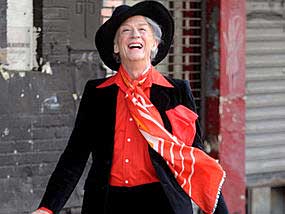 Crisp
loves New York and he adores stardom. Crisp tells friends that he has stopped
buying food and simply attends every cocktail party to which he is invited.
Expected to "sing for his supper" at these functions, he downplays being
a "hero" and remains largely apolitical. When he sashays down the streets
now, he revels in the way that everyone is on display and not just
him. The mood is, again, exuberant and the music during these early scenes
is a hybrid of "Theme from Shaft" and 70s television fodder like
Charlie's Angels and Starsky and Hutch. The right comic touches
are nailed and viewers will, again, be enchanted. Crisp
loves New York and he adores stardom. Crisp tells friends that he has stopped
buying food and simply attends every cocktail party to which he is invited.
Expected to "sing for his supper" at these functions, he downplays being
a "hero" and remains largely apolitical. When he sashays down the streets
now, he revels in the way that everyone is on display and not just
him. The mood is, again, exuberant and the music during these early scenes
is a hybrid of "Theme from Shaft" and 70s television fodder like
Charlie's Angels and Starsky and Hutch. The right comic touches
are nailed and viewers will, again, be enchanted. |
|
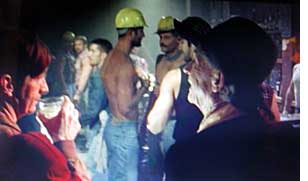 Those
familiar with The Naked Civil Servant
will recognize Crisp's aversion to housework when the camera pans through
his messy apartment. ("After four years, the dust doesn't get any worse.")
We are also reacquainted with Crisp's futile quest to find the "great dark
man" of his dreams who would never be interested in him. During
a visit to The Anvil, (in flagrant disregard of the legendary bar's dress
code), Crisp observes the leather men and clones and notes that "they operate
on the principle that in order to find the great dark man you first have
to look like him." In a scene that mirrors one from the first film, Crisp's
appearance is at such odds with the rest of the bar's butch clientele that
he is asked to leave. Those
familiar with The Naked Civil Servant
will recognize Crisp's aversion to housework when the camera pans through
his messy apartment. ("After four years, the dust doesn't get any worse.")
We are also reacquainted with Crisp's futile quest to find the "great dark
man" of his dreams who would never be interested in him. During
a visit to The Anvil, (in flagrant disregard of the legendary bar's dress
code), Crisp observes the leather men and clones and notes that "they operate
on the principle that in order to find the great dark man you first have
to look like him." In a scene that mirrors one from the first film, Crisp's
appearance is at such odds with the rest of the bar's butch clientele that
he is asked to leave. |
|
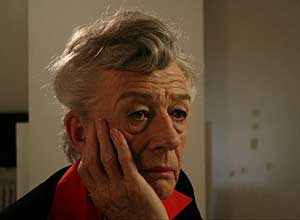 Thus
far, the film has been fun. But then viewers who aren't intimate with Crisp's
background will receive an unexpected jolt. An
Englishman In New York doesn't shy away from the more controversial
facets to Crisp's twilight years and Fillis' script is a warts-and-all portrait
of the artist. Crisp became anathema to the gay community in 1983 with his
own John Lennon "The Beatles are bigger
than Jesus" faux pas. During one of his shows, Crisp is asked about AIDS
and he shocks his audience by replying that "homosexuals are forever complaining
about one ailment or another. AIDS is a fad, nothing more." Suddenly there
is no more laughter, just dead silence. Thus
far, the film has been fun. But then viewers who aren't intimate with Crisp's
background will receive an unexpected jolt. An
Englishman In New York doesn't shy away from the more controversial
facets to Crisp's twilight years and Fillis' script is a warts-and-all portrait
of the artist. Crisp became anathema to the gay community in 1983 with his
own John Lennon "The Beatles are bigger
than Jesus" faux pas. During one of his shows, Crisp is asked about AIDS
and he shocks his audience by replying that "homosexuals are forever complaining
about one ailment or another. AIDS is a fad, nothing more." Suddenly there
is no more laughter, just dead silence. |
|
 Coupled
with his previous dismissal of gay liberation, and his refusal to get involved
in gay causes, the backlash is immediate. Crisp's speaking engagements are
canceled, he loses his writing gig with the Native. Ignoring the
advice of his colleagues, he refuses to retract or apologize for his ill
chosen words. To do so, he claims, would call into question everything he
has ever said. It is hard to comprehend that Crisp could have been so oblivious
but how could he know, at the time, that AIDS would still have no
cure almost thirty years later? His thoughtless observation is still inexcusable,
yet he is strangely prophetic when he says that "to create a hysteria around
this disease would play into the hands of your enemies. They would say that
homosexuality and disease go hand in hand." (Jesse Helms and Pat Buchannon
anyone?) Coupled
with his previous dismissal of gay liberation, and his refusal to get involved
in gay causes, the backlash is immediate. Crisp's speaking engagements are
canceled, he loses his writing gig with the Native. Ignoring the
advice of his colleagues, he refuses to retract or apologize for his ill
chosen words. To do so, he claims, would call into question everything he
has ever said. It is hard to comprehend that Crisp could have been so oblivious
but how could he know, at the time, that AIDS would still have no
cure almost thirty years later? His thoughtless observation is still inexcusable,
yet he is strangely prophetic when he says that "to create a hysteria around
this disease would play into the hands of your enemies. They would say that
homosexuality and disease go hand in hand." (Jesse Helms and Pat Buchannon
anyone?) |
|
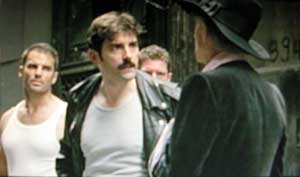 Crisp
is directly confronted by a group of leathermen about his comments during
the film's best scene. The set-up closely resembles one of the street scenarios
in which was Crisp was beaten up in the first movie. Crisp is taken aback
by their accusations and the look on his face as he finally comprehends
the full weight of his insensitive remarks is devastating. At a loss for
words, he comes the closest that he ever will to delivering an apology.
("I must insure that the words that upset you are never said again.") Words
aren't even necessary to convey his inner turmoil; Hurt's craggy face almost
erodes in front of us and the light extinguishes from his eyes. Crisp
is directly confronted by a group of leathermen about his comments during
the film's best scene. The set-up closely resembles one of the street scenarios
in which was Crisp was beaten up in the first movie. Crisp is taken aback
by their accusations and the look on his face as he finally comprehends
the full weight of his insensitive remarks is devastating. At a loss for
words, he comes the closest that he ever will to delivering an apology.
("I must insure that the words that upset you are never said again.") Words
aren't even necessary to convey his inner turmoil; Hurt's craggy face almost
erodes in front of us and the light extinguishes from his eyes. |
|
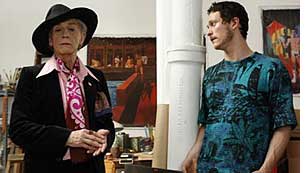 Two
story arcs dominate the rest of the film's running time. Crisp befriends
a young gay artist named Patrick Angus (Jonathan Tucker) and helps him achieve
modest success before he succumbs to AIDS complications. Angus, like Crisp,
also doesn't believe in love and refers to the subjects of his paintings
as his great dark men. "There is no great dark man," Crisp sadly tells him.
"I know, I've looked." After a ten year hiatus from the stage, Crisp joins
forces with performance artist Penny Arcade (Cynthia Nixon) for a series
of shows. As he grows ancient before our eyes, Steele becomes Crisp's caregiver
and the touching relationship that grows between them almost resembles that
of a longtime married couple. There is a lot of talk about death during
the last scenes; some of it witty, some of it schmaltzy. Crisp has mellowed
and there's a wonderful moment where Steele discovers that the old writer
has been sending checks to AIDS charities. Characteristically, Crisp insists
"It's just so I can meet Miss Taylor." Two
story arcs dominate the rest of the film's running time. Crisp befriends
a young gay artist named Patrick Angus (Jonathan Tucker) and helps him achieve
modest success before he succumbs to AIDS complications. Angus, like Crisp,
also doesn't believe in love and refers to the subjects of his paintings
as his great dark men. "There is no great dark man," Crisp sadly tells him.
"I know, I've looked." After a ten year hiatus from the stage, Crisp joins
forces with performance artist Penny Arcade (Cynthia Nixon) for a series
of shows. As he grows ancient before our eyes, Steele becomes Crisp's caregiver
and the touching relationship that grows between them almost resembles that
of a longtime married couple. There is a lot of talk about death during
the last scenes; some of it witty, some of it schmaltzy. Crisp has mellowed
and there's a wonderful moment where Steele discovers that the old writer
has been sending checks to AIDS charities. Characteristically, Crisp insists
"It's just so I can meet Miss Taylor." |
|
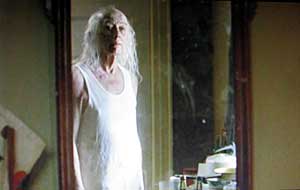 Hurt,
again, is outstanding as Crisp. He is equally adept at capturing the man's
catty wit, his arrogance, and finally his intense sadness as he grows older
and older. His flamboyance diminishes with age and it is almost painful
to watch his slow deterioration. The make-up job on Hurt as he ages is superb.
The film's second half loses steam in spots but always remains engaging
because of Hurt. The Naked Civil Servant
is the better of the two movies, but An Englishman
In New York is a worthy successor. I find few flaws but the
new film seems more like a made-for-televison movie than its predessesor,
expecially when the director insists on adding banal piano cues to accompany
Crisp's meaningful stares when silence would have been more effective. But
my quibbles are small because, even at its weakest moments, Hurt continues
to command your attention and Crisp's story is one well worth telling. Hurt,
again, is outstanding as Crisp. He is equally adept at capturing the man's
catty wit, his arrogance, and finally his intense sadness as he grows older
and older. His flamboyance diminishes with age and it is almost painful
to watch his slow deterioration. The make-up job on Hurt as he ages is superb.
The film's second half loses steam in spots but always remains engaging
because of Hurt. The Naked Civil Servant
is the better of the two movies, but An Englishman
In New York is a worthy successor. I find few flaws but the
new film seems more like a made-for-televison movie than its predessesor,
expecially when the director insists on adding banal piano cues to accompany
Crisp's meaningful stares when silence would have been more effective. But
my quibbles are small because, even at its weakest moments, Hurt continues
to command your attention and Crisp's story is one well worth telling. |
|
|
Both discs feature superb supplements. The Naked Civil Servant sports an informative commentary by Hurt and the director, and An Englishman in New York contains a documentary plus a featurette on Hurt as Crisp. Both discs are highly recommended.
|
|
 |
|
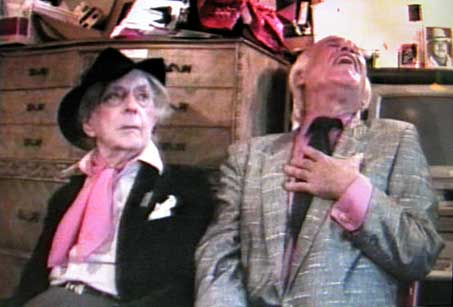
| The real Quentin Crisp has a major supporting role in Red Ribbons, a 1994 film from writer/director Neil Ira Needleman. Red Ribbons is a comedic drama that tells the story of a group of friends who meet to pay tribute to a fallen comrade, Frank David Niles, who has just died from AIDS complications. Niles (Christopher Cappiello) was the founder of In Your Face, a controversial theatre troupe. The man's plays included such titles as The Trojan War: A Condom Caper, Pink Triangles and Two Lesbians From Verona. It is the day after his funeral and his surviving partner, Robert (Robert Parker), finds himself with an apartment full of visitors who have come to pay their respects. | |
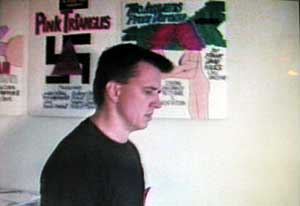 The
guests include his sister, Carolyn (Princess Sandlin), a gay theatre critic
from The Village Voice (William J. Ingersol), and several members
of Niles' theatrical troupe: a lesbian couple (Lee Sharmat, Colleen O'Neill)
and two hammy actors, who are also longtime partners, played by Quentin
Crisp and Victor Burgess. (Crisp's character is named Horace Nightingale
III.) Carolyn's homophobic ex-husband stops by to sign divorce papers, and
Robert is dreading a visit from Niles' estranged mother, played by former
porn actress Georgina Spelvin (The Devil In Miss Jones). The film,
shot with a handheld video camera, combines the events at this gathering,
supplemented by flashbacks via Niles' video diary. The
guests include his sister, Carolyn (Princess Sandlin), a gay theatre critic
from The Village Voice (William J. Ingersol), and several members
of Niles' theatrical troupe: a lesbian couple (Lee Sharmat, Colleen O'Neill)
and two hammy actors, who are also longtime partners, played by Quentin
Crisp and Victor Burgess. (Crisp's character is named Horace Nightingale
III.) Carolyn's homophobic ex-husband stops by to sign divorce papers, and
Robert is dreading a visit from Niles' estranged mother, played by former
porn actress Georgina Spelvin (The Devil In Miss Jones). The film,
shot with a handheld video camera, combines the events at this gathering,
supplemented by flashbacks via Niles' video diary. |
|
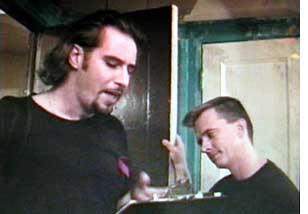 Combing
pathos and over-the-top comedy, Red Ribbons
is a well-meaning but ultimately amateurish film. Calling it "stiff"
would be polite. The acting ranges from good to terrible. From the amount
of scene chewing that goes on, I suspect that most of the cast consists
of stage actors who needed to be told to tone it down for the camera. Crisp
looks like a wax figure throughout. Entire scenes are usually played out
in one shot and this was probably a budgetary choice rather than an aesthetic
one. The subject is worthy of our consideration, its execution just leaves
much to be desired. Much of Red Ribbons
is painful. It's hard not to laugh at lines like "Another martyr... how
many martyrs must there be.... the streets are sacrificing you, you and
every other queer with AIDS!" Yet every time I was going to eject the disc,
something would happen to seize my interest. The trouble is, these moments
usually don't last for very long. Combing
pathos and over-the-top comedy, Red Ribbons
is a well-meaning but ultimately amateurish film. Calling it "stiff"
would be polite. The acting ranges from good to terrible. From the amount
of scene chewing that goes on, I suspect that most of the cast consists
of stage actors who needed to be told to tone it down for the camera. Crisp
looks like a wax figure throughout. Entire scenes are usually played out
in one shot and this was probably a budgetary choice rather than an aesthetic
one. The subject is worthy of our consideration, its execution just leaves
much to be desired. Much of Red Ribbons
is painful. It's hard not to laugh at lines like "Another martyr... how
many martyrs must there be.... the streets are sacrificing you, you and
every other queer with AIDS!" Yet every time I was going to eject the disc,
something would happen to seize my interest. The trouble is, these moments
usually don't last for very long. |
|
|
Nevertheless, the movie is a time capsule of sorts. I received no press on this film, and pickings on the web are slim, and so I know nothing about anyone except Crisp and the former porn queen (and that only through imdb.com listings). But it might be safe to assume that the actors were known in the New York City theatre and art circles. Admirers of Mr. Crisp might be captivated by his final feature film appearance, even if he seems to be sleeping through parts of it. The DVD also includes three short films by the same director, Aunt Fannie (also starring Crisp), Renovation, and The Divine Ms. Q, an excerpt from one of Crisp's one man shows.
John Hurt also
appears in: Denis O'Hare also
appears in: Quentin Crisp
also appears in: |
|
|
|
 As
a young man during the 1920s and 30s, Crisp lived his life the way he
wanted when homosexuality was against the law in England. Call him courageous,
call him foolhardy, but he made himself so obvious that he might as well
have carried a sign that said "You May Beat Me Up Now." Channeling
As
a young man during the 1920s and 30s, Crisp lived his life the way he
wanted when homosexuality was against the law in England. Call him courageous,
call him foolhardy, but he made himself so obvious that he might as well
have carried a sign that said "You May Beat Me Up Now." Channeling 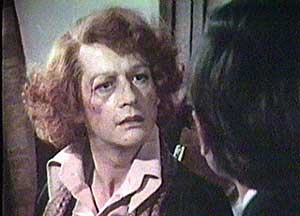 Hurt
has been on my radar ever since I first saw him as the mad Roman Emperor,
Caligula, in the 1976 Masterpiece Theatre production of I, Claudius.
Hurt's Caligula was sometimes as fey as his Crisp. Most notable was a
scene where he danced in drag for a stunned Claudius who had thought he'd
been summoned to the palace to be killed. The less said about 1982's Partners
(with Ryan O'Neal) the better, check out David Lynch's The Elephant
Man (1980) instead. Hurt even steals the show in the new Indiana Jones
flick. I highly recommend 1997's
Hurt
has been on my radar ever since I first saw him as the mad Roman Emperor,
Caligula, in the 1976 Masterpiece Theatre production of I, Claudius.
Hurt's Caligula was sometimes as fey as his Crisp. Most notable was a
scene where he danced in drag for a stunned Claudius who had thought he'd
been summoned to the palace to be killed. The less said about 1982's Partners
(with Ryan O'Neal) the better, check out David Lynch's The Elephant
Man (1980) instead. Hurt even steals the show in the new Indiana Jones
flick. I highly recommend 1997's 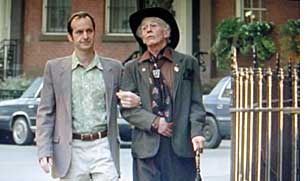 You
don't have to watch the two films together; each stands on its own. But
there is no denying that a viewing of the second film will be enriched
from having seen the first. Happily, Hurt chose to reprise the role that
made him famous and audiences everywhere will be enriched by his portrayal.
A pioneer who - for a time - also became a pariah, Quentin Crisp was a
true original whose gay icon status remains assured.
You
don't have to watch the two films together; each stands on its own. But
there is no denying that a viewing of the second film will be enriched
from having seen the first. Happily, Hurt chose to reprise the role that
made him famous and audiences everywhere will be enriched by his portrayal.
A pioneer who - for a time - also became a pariah, Quentin Crisp was a
true original whose gay icon status remains assured. 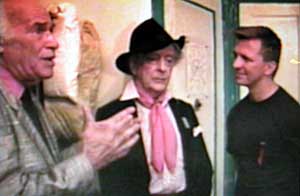 Good
intentions do not a good film make, but one cannot fault the director
for his ambitions. Red Ribbons
is a thematically rich film that explores the devasting effects of AIDS,
longtime closed and open relationships, homophobia, responsibility, activist
theatre and the shared camaraderie of gay artists working for a common
goal. With a script rewrite (or some help from a dramaturge to whip the
material into shape) and cinematography that looks less like a home movie,
this film could have been a small gem.
Good
intentions do not a good film make, but one cannot fault the director
for his ambitions. Red Ribbons
is a thematically rich film that explores the devasting effects of AIDS,
longtime closed and open relationships, homophobia, responsibility, activist
theatre and the shared camaraderie of gay artists working for a common
goal. With a script rewrite (or some help from a dramaturge to whip the
material into shape) and cinematography that looks less like a home movie,
this film could have been a small gem.